Change may be the context for leadership and relative stability the context for management. Leaders define reality (DePree, 1989) and managers sseemingly deal with facts. Leaders provide vision, the new reality, and managers produce the details. Leaders navigate uncertainty while managers mitigate risk. Perhaps it follows then that managers use logic and leaders play in the domain of our emotions.
Change involves uncertainty which builds anxiety that stimulates our emotions. When leaders promote change associated with a new vision for a new reality, leaders need to remember the uncertainty, anxiety, and emotional components of change. As we watch states like Wisconsin (others will follow) and nations like Bahrain, Yemen, Egypt, Tunisia, Iran, Iraq, Afghanistan, Kenya, Uganda, Ivory Coast, and Sierra Leone (with more to come) address change or its possibility, if not promise, a critical point to watch will be how leaders address the emotional response that arises on all sides of the discussion, debate, or battle for or against a new vision for a new reality.
Some leaders may stimulate emotions like anger, fear, and resentment. Other leaders may provoke joy, hope, and courage. Who does what will depend on the leader and the target audience and, of course, the particular vision that leader champions.

An ongoing study of leadership roles, practices, and behaviors explores distinctions between individuals who disclose that they personally or their companies were financially harmed in the recent economic downturn and those who indicate that they or their companies experienced no financial harm. The responses vary by country.
Economic harm seems more likely among residents of Europe and North America than in Africa, Asia, Australia, or South America. Respondents from North America to date see 70% of 280 reporting financial harm while residents of Europe to date see 58% of 36 reporting a negative financial impact from the economic downturn. Africa, Asia, Australia, and South America reported 43%, 47%, 42%, and 71% respectively. If leading during economic recovery is different from leading at other times, and residents of Europe and the Americas are more likely to have experienced economic trauma than residents in the rest of the world, then we might expect leadership in Europe and the Americas to look differently than leadership elsewhere as the economic recovery proceeds.
Two somewhat universal themes emerge from research and experience. The first theme is that leaders rise to the surface. People display leadership that is disconnected to the position that they hold. When looking for leaders in organizations, we should not limit our search to people in somewhat traditional positions of leadership. It may be that future holders of positions of leadership come out of the ranks of leaders whose leadership is unrelated to their position. At the moment, these leaders have followers and these followers, rather than organizations or communities, give them power or authority based on the value that they bring.
Goals and Barriers – An Overview
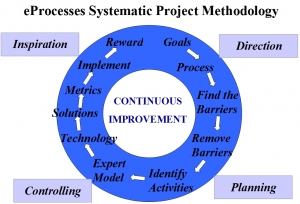
A critical first step in achievement of superior organizational and individual performance is the determination of short-term organization-wide goals. This is a matter of defining the macro level expectations of the organization. Once the necessary direction for the organization has been determined, that direction can be translated down through the organization so that all departments and individuals are committed to working toward achievement of the overall goals. In order to do this, each department must have its own set of goals that support the goals of each piece of the company above it in the organizational structure.
In the process of “translating” organization-wide goals to departments and individuals, barriers will surface. These barriers become not an excuse but a roadmap by which the organization can achieve its goals.
The key to using identified barriers to reach organizational goals is to create prioritized action plans for the removal of those barriers. This avoids the phenomenon of employees feeling that they are removing barriers for the sake of removing barriers. The motivation is clear when there is a logical connection established between the barrier and an acknowledged organization-wide goal.
Organizational Alignment eProcesses begins to understand the level of organizational alignment with respect to a set of goals during the Initial Evaluation stage. During this stage, eProcesses starts with identification of the organization-wide set of goals. Our efforts toward improved alignment continue throughout the relationship between client and consultant.
Companies give a wide range of reasons for investing in technology: improve quality, reduce costs, shorten lead times, improve consistency, and improve communication are a few common ones.
Each of these reasons, and most of the other reasons that could be offered, have an explicit or implicit basis for the technology purchase decision. And, behind each of these decisions, is explicit and implicit integration of the new technology with the company’s people and processes.
This integration does not happen spontaneously. Quite to the contrary, effective integration of technology, processes, and people requires implementation experience, focus, and support at the highest levels of the company. High level support is required because the introduction of new technology changes processes and behaviors. Behavioral change does not come easily. It often meets with significant resistance. The nature of many organizations is such that resistance to change often receives high-level support itself. Without top-level support for the change initiative, the required behavioral change may not happen.
The most frequent process-related challenge is the failure to consider the impact of the new technology on specific processes. Sometimes this failure occurs because some processes are overlooked in the implementation planning process. The more common scenario, however, is that companies, even successful ones, don’t take the time to understand their processes.
ROI, Not a Model, a Process At eProcesses we see most Cost Justifications and or Return on Investment documents for technology investments following the normal Rate of Return, Payback Period, Net Present Value, etc. model. Though sound from a financial point of view, there are underlying elements that are overlooked when it comes to new technology.
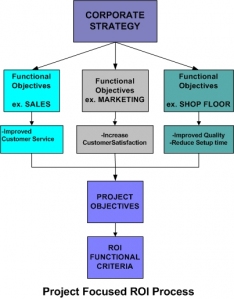
The chart represents a process where Corporate Strategies/Goals are the starting point for financial analysis. The process then moves to the departments/business units that are going to be involved in the new technology. The departments define their ‘Functional Objectives’ with the new technology and, therefore, capture the motivation for the investment and the business objectives that are to be achieved. These objectives and motives have value and provide direction for the ensuing project. It is up to the project team to quantify the value and include it in the ROI calculation. All of this is then moved to initial starting point of the technology project.
Integration of Business Processes and Human Behaviors with Technology To truly achieve the full benefit of your technology investment, eProcesses suggests there is another element to consider. eProcesses observes that companies usually invest in technology to achieve greater value from their Human Resources. But we rarely encounter companies who make the other investment that is required to realize the benefits, the real integration of the new technology into the processes and behaviors of the organization. The ROI that convinced you to invest in hardware or software throughout the company had an underlying assumption that you would change the way you do business. At eProcesses we help you change the way you do business. We help you realize the ROI you initially expected when you invested in the technology.
Technical vs. Process vs. People Integration Integration is a term that is commonly used, frequently without agreement as to definition. A dictionary definition of “integration” would say “the act of forming, coordinating, or blending into a functioning or unified whole.” It is commonly used, especially in association with technology, purely from the perspective of systems integration. In practice, however, even systems integration involves much more than integrating systems.
At eProcesses, when we speak of integration we speak of technical or systems integration but extend systems to include not only technology but business processes and people and their behavior. We believe that a company cannot realize the full value of its investment in technology, in business processes, or in people unless all three are integrated into a effective, efficient, well-tuned whole.
Technical Integration and ECR New technology is a common path that companies take to improve organizational performance. Rarely will a company make an investment in technology without the expectation of an appropriate return on investment. Companies understand that new tools or technologies may be required to improve the capabilities of their workforces and to improve the capacity of the organization. Technology is seen as a way to improve the efficiency of the workforce or the throughput of a plant or the service level that can be provided.
A leaderless attempt to transform Egypt? Following the events of the past week or so, I am struck by the increasingly frequent references to the lack of visible leaders to the protests calling for the ouster of the current president of Egypt. Recent television commentary suggests that the protests began with text messages and online discussions that thus far are not attributed publicly to anybody.
Is it possible for a virtual network to take on the characteristics of leadership? Is the current situation one in which the initiators of the protest movement are remaining in the background, perhaps for their own safety, while others collectively lead?
While the ousting of the current Egyptian president is the presenting issue, is this an example of diverse groups with potentially conflicting goals and objectives rallying around the one point on which they all agree? If so, who will sort out the potentially significant differences and how? Who will ultimately emerge from the reported chaos to unify and lead in Egypt?
Egypt protests As events continue to unfold in Egypt, Tunisia, Lebanon, Yemen, Jordan, and elsewhere, what new leaders will emerge? What roles, practices, and behaviors will the citizens of countries seek? What leadership style will emerge for the evolving context of these countries? Will the leadership style be charismatic, collegial or collaborative, autocratic, situational, or something else, even a unique, situationally-based style?